Article
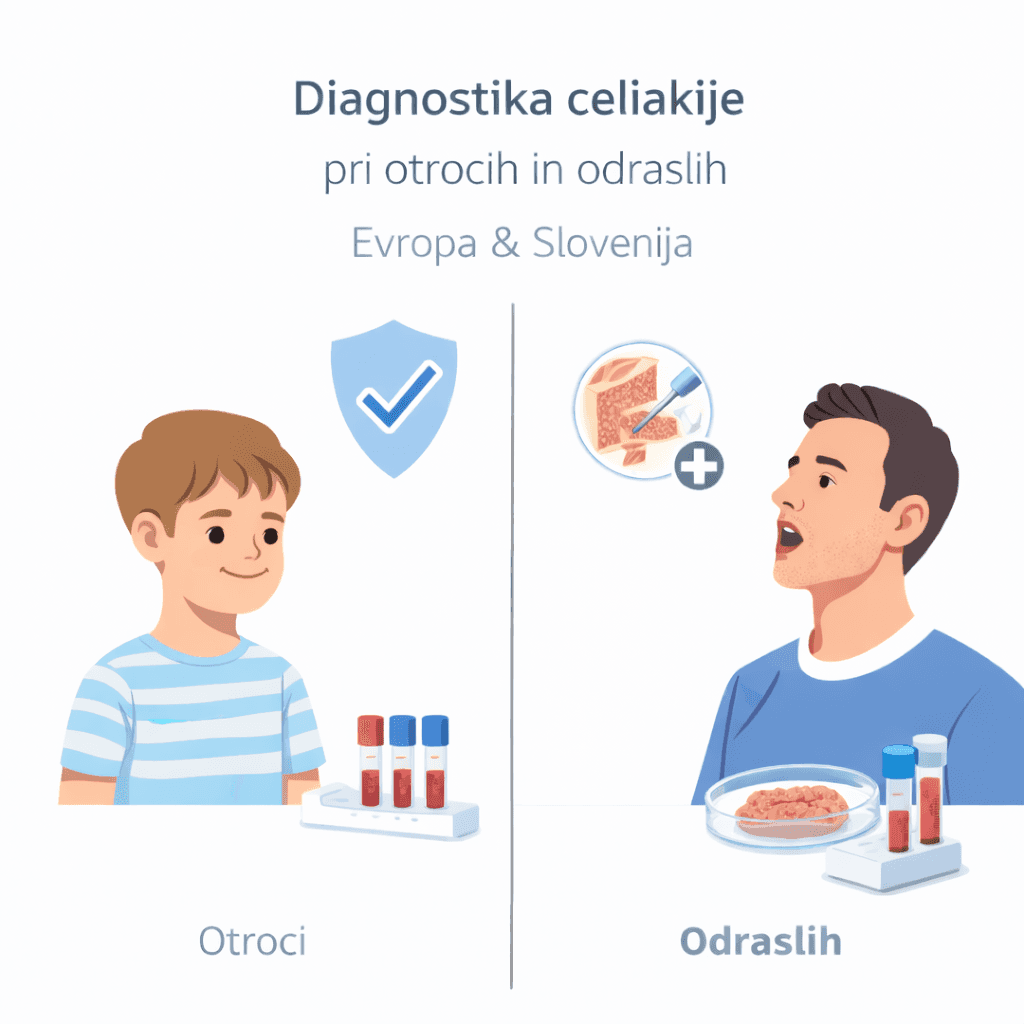
Diagnosis of coeliac disease in children
European and Slovenian guidelines for the diagnosis of coeliac disease in children are primarily based on the recommendations of ESPGHAN (European Society for Paediatric Gastroenterology, Hepatology and Nutrition). These guidelines allow for a more modern and less invasive approach in cases where strict diagnostic criteria are met.
Possibility of Diagnosis Without Biopsy
In children and adolescents, according to the current guidelines, a diagnosis without gastroscopy is possible in certain cases if all the following conditions are simultaneously met:
very high levels of tTG-IgA antibodies, at least 10 times above the upper limit of normal,
confirmation with another test, i.e., positive endomysial antibodies (EMA-IgA) in a separate blood sample,
confirmation of the diagnosis by a specialist, where the paediatric gastroenterologist confirms the diagnosis in cooperation with the parents or guardians.
According to the latest guidelines, genetic testing (HLA-DQ2/DQ8) is no longer mandatory in these cases if the above criteria are met.
When is a Biopsy Still Necessary in Children?
Gastroscopy with a biopsy of the small intestine is still recommended in children when:
tTG-IgA levels are not sufficiently elevated (less than 10 times above the threshold),
the child has IgA deficiency,
the results are unclear or contradictory,
there is doubt about the diagnosis or atypical symptoms are present.
Diagnosis of Coeliac Disease in Adults
In adults, diagnostic procedures are different and generally more conservative. Slovenia follows the recommendations of European gastroenterological associations, such as ESGE, BSG, and other professional bodies.
Key Difference: Biopsy Remains Standard
Unlike in children, the diagnosis of coeliac disease in adults still generally requires gastroscopy with a biopsy of the small intestine, even when antibody levels are very high.
Reasons for this include:
greater variability in symptoms and disease progression in adults,
higher risk of other diseases with similar findings,
greater variability of serological results,
the need to exclude other causes of intestinal mucosal damage.
Diagnostic Procedure in Adults
Diagnosis in adults usually involves several sequential steps.
First, blood tests, primarily:
tTG-IgA as the basic screening test,
total IgA to exclude deficiency,
if necessary, EMA-IgA or IgG tests.
This is followed by gastroscopy with a biopsy, where multiple samples are taken from the duodenum and histologically confirmed for mucosal damage, mainly villous atrophy.
Genetic testing (HLA-DQ2/DQ8) is also performed if needed, which is mainly useful for ruling out the disease.
Is Diagnosis Without Biopsy in Adults Possible?
In the professional literature, there is also a discussion about the possibility of diagnosis without biopsy in adults with very high antibody levels. However, this approach:
is not yet routinely accepted,
is not standard practice in Slovenia and most of Europe,
a biopsy remains recommended and expected.
Therefore, gastroscopies are generally not omitted in adult patients, even with distinctly positive antibodies.
Important Common Warnings (Children and Adults)
Some key rules apply regardless of age:
The person must consume gluten until the diagnostic process is complete.
An early switch to a gluten-free diet can lead to false-negative results.
The diagnosis of coeliac disease is lifelong and requires clear, documented confirmation.
After diagnosis, regular monitoring and professionally guided gluten-free diet is essential.
Conclusion
Modern European guidelines allow coeliac disease to be diagnosed in many children without invasive procedures when strict diagnostic criteria are met. In adults, however, a small intestine biopsy remains a key part of the diagnostic process.
Such a differentiated approach ensures a reliable diagnosis, patient safety, and long-term appropriate disease management.
Blog posts