BLOG
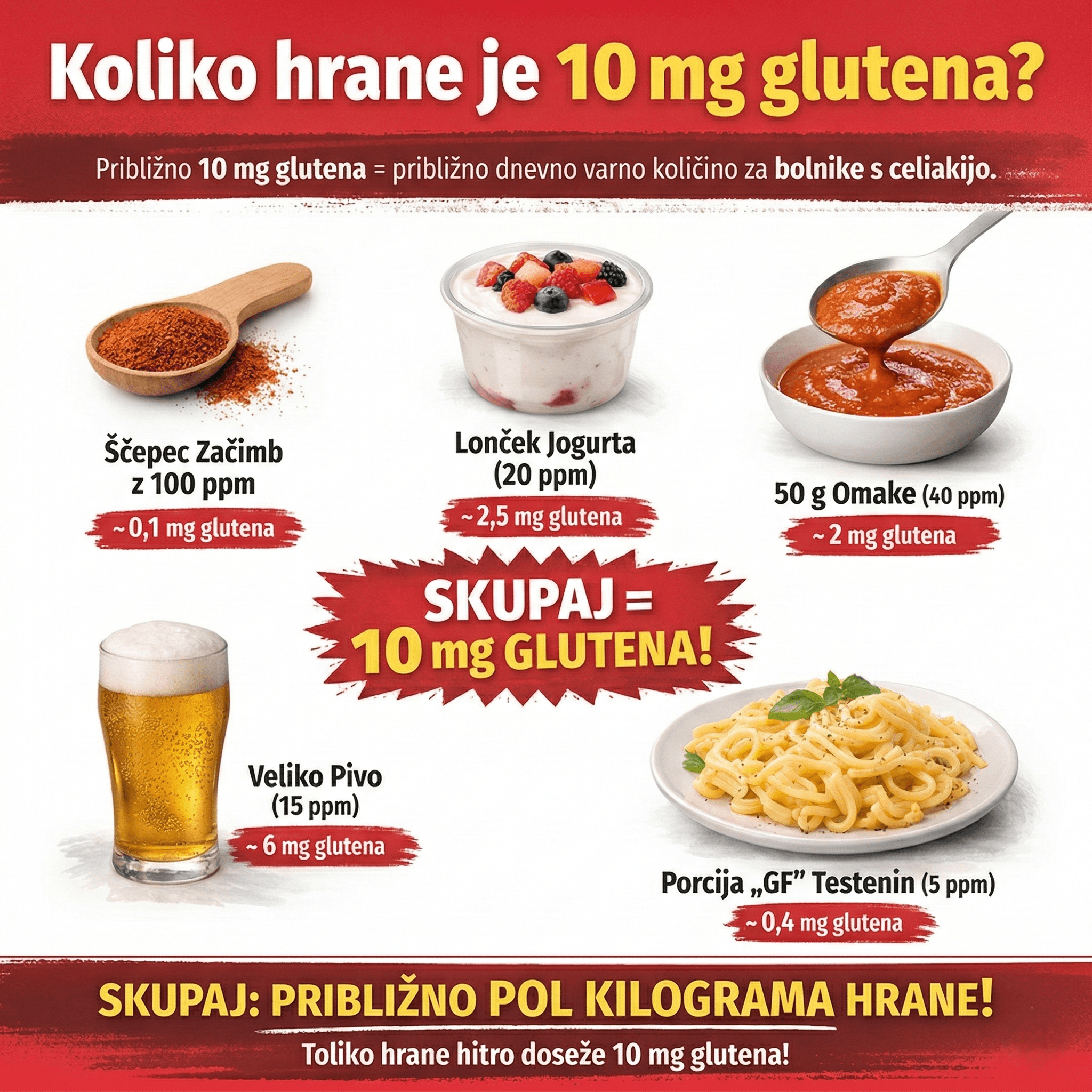
What does ppm mean?
PPM (parts per million) means parts per million.
Mathematically this means:
1 ppm = 1 part per 1,000,000 parts
In food this means:
1 ppm = 1 mg of a substance in 1 kg of food
Example:
20 ppm means 20 mg of gluten in 1 kg of food.
This corresponds to approximately 0.002% gluten.
It is important to understand that ppm describes the concentration of gluten in food, not the actual amount a person consumes.
Concentration (ppm) vs. actual dose (mg)
The difference between concentration and consumed quantity is crucial.
Example
Food: spices
Contamination: 100 ppm
Portion: 1 g
Calculation:
100 mg/kg × 0.001 kg = 0.1 mg of gluten
Food: beer
Contamination: 15 ppm
Portion: 1 litre
Calculation:
15 mg/kg × 1 kg = 15 mg of gluten
This example shows an important fact:
A small amount of food with high ppm can contain very little gluten.
A large amount of food with low ppm can contain much more gluten.
Therefore ppm alone does not describe the real risk.
Why the 20 ppm limit exists
The standard for labeling foods ‘gluten-free’ is defined by the Codex Alimentarius Commission, which operates under the Food and Agriculture Organization (FAO) and the World Health Organization (WHO).
It states that a food labelled ‘gluten-free’ must contain:
less than 20 mg of gluten per kilogram of food (20 ppm).
This limit represents a balance between:
patient safety
technical limits of laboratory testing
real-world manufacturing conditions
If a person eats approximately 500 g of food containing 20 ppm gluten, they would consume about 10 mg of gluten.
Key clinical research on gluten thresholds
The most important research in this field was conducted by Carlo Catassi.
In a randomised double-blind study, patients consumed for 90 days:
0 mg gluten per day
10 mg gluten per day
50 mg gluten per day
Results showed:
10 mg/day did not cause histological damage in most patients.
50 mg/day caused damage to intestinal villi.
Because of this, many clinical guidelines use 10 mg of gluten per day as a conservative safety threshold.
Real contamination of food
Large analyses of food products show that most gluten-free products are well below the legal limit.
Studies analysing thousands of gluten-free products in Europe found that the vast majority comply with the 20 ppm limit defined in European legislation.
Other studies have shown that even in regular foods without gluten ingredients, actual contamination is often very low, including products labeled ‘may contain traces of …’.
Food | ppm | Portion | Gluten |
|---|---|---|---|
Spices | 100 ppm | 1 g | 0.1 mg |
Sauce | 40 ppm | 50 g | 2 mg |
Yogurt | 20 ppm | 125 g | 2.5 mg |
Beer | 15 ppm | 660 ml | 9.9 mg |
Pasta | 5 ppm | 80 g | 0.4 mg |
This table shows an interesting paradox:
ppm alone does not describe the real risk.
Conclusion
For celiac disease it is crucial to understand the difference between two numbers:
20 ppm
the regulatory standard for food labeling.
10 mg of gluten per day
an approximate biological threshold for most patients.
The real risk therefore depends mainly on:
the total amount of food consumed,
the total daily intake of gluten,
and not simply on a single number in a laboratory result.
Scientific sources
Catassi C. et al. (2007). A prospective double-blind placebo-controlled trial to establish a safe gluten threshold. American Journal of Clinical Nutrition.
Fasano A. (2012). Celiac disease: from pathophysiology to therapy.
Sapone A. et al. (2012). Spectrum of gluten-related disorders.
Silano M. et al. (2016). Gluten exposure and immune response in celiac disease.
Rasmussen S. N. et al. (2022). Risk of consuming products with precautionary gluten labelling.
Losio M. N. et al. (2022). Gluten quantification in gluten-free foods.
Blog posts