
Article
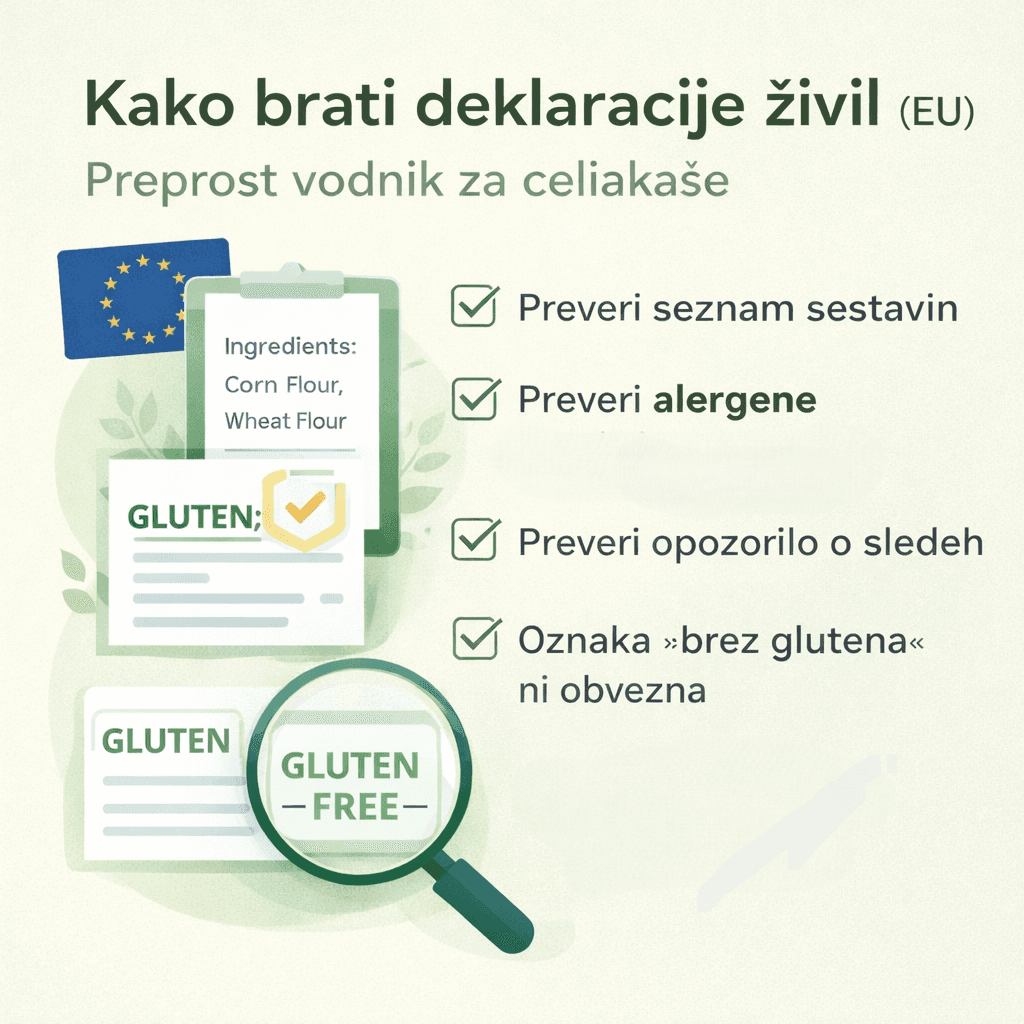
Why is reading declarations crucial?
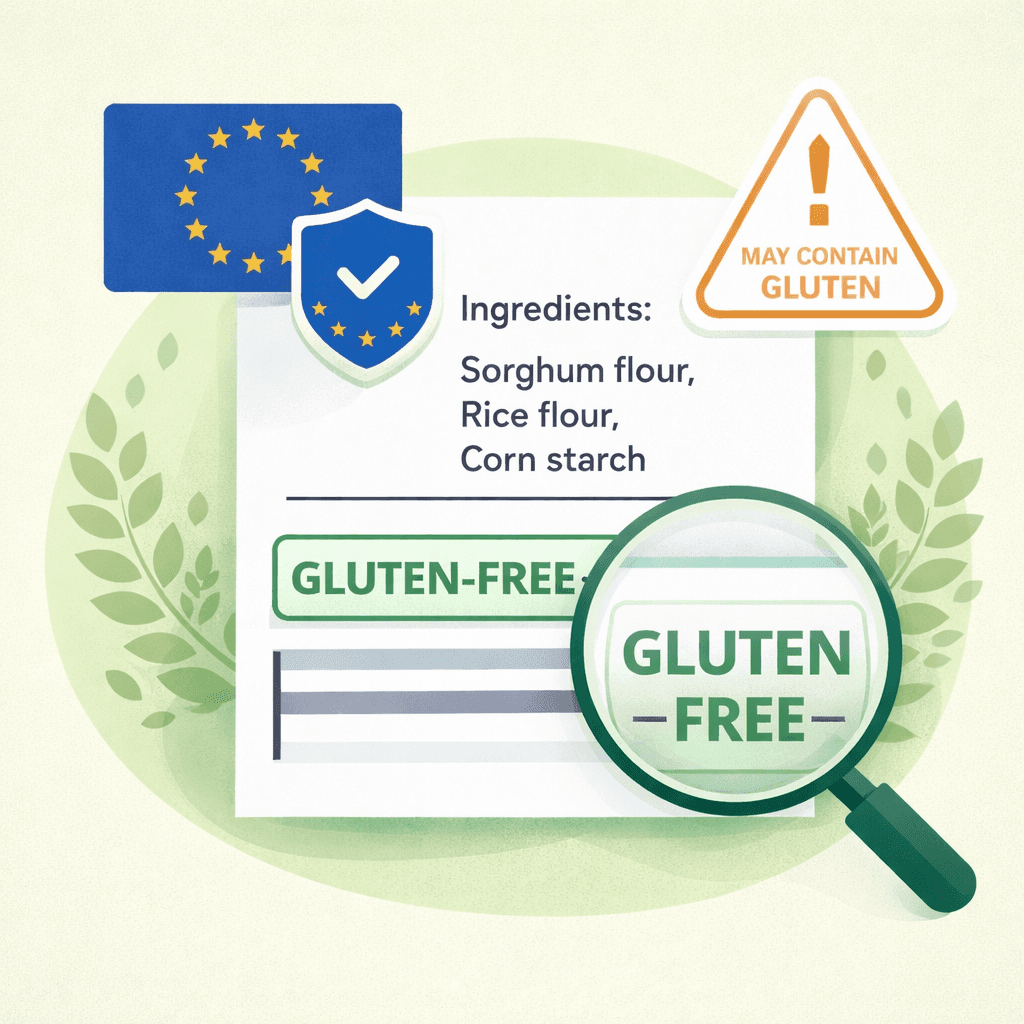
In recent years, a lot of misinformation has spread among people with coeliac disease about which foods are safe and which are not. Often, there is fear of products that do not have the 'gluten-free' label, even though they are completely safe according to EU legislation.
The main reason for this is a misunderstanding of European legislation and the transfer of practices and recommendations from individual countries without considering the actual legal framework. The rules in the EU are uniform and apply to all member states, including Slovenia.
In order to clarify these issues, the Italian association AssoCeliaci has prepared an educational video that is based exclusively on valid EU legislation. The video helps explain how to correctly read labels, when a food is safe, and why the 'gluten-free' label is not always necessary.
What does EU legislation say about gluten?
The primary legal act in the field of food labelling is Regulation (EU) No. 1169/2011, which stipulates that all allergens, including gluten, must always be clearly indicated in the list of ingredients if present.
This means that gluten:
must not be hidden,
must not be listed by E-numbers,
must not be omitted from the declaration.
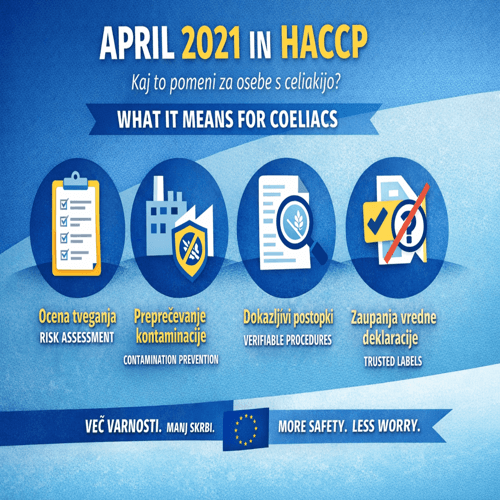
Additionally, Regulation (EU) No. 828/2014 lays down the conditions for the use of the statements 'gluten-free' and 'very low gluten'. It is important to understand that the 'gluten-free' label is voluntary, and its absence does not mean that the product is unsafe.
If a product contains no gluten ingredients and has no warning about possible traces of gluten, it is considered safe for people with coeliac disease under EU legislation.
What does ‘may contain traces’' mean?
Warnings such as 'may contain traces of gluten' are not randomly added or just out of precaution. Manufacturers can only use them based on documented risk assessments for cross-contamination.
If there is no risk, there should be no warning, as it would be misleading. Labelling for traces of gluten is therefore a legal obligation based on expert assessment and not a matter of the manufacturer’s personal choice.
Why are products often labelled differently in Italy?
It is often questioned why some products are labelled 'senza glutine' in Italy but not elsewhere in the EU, even though they are the same products.
The reason is not legislation, as it is uniform across the EU. The difference lies in the Italian system, where there is a special register of gluten-free products managed by the AIC association. If a manufacturer wants inclusion in this register, the product must be labelled as 'senza glutine', even if it already naturally meets the conditions.
In Slovenia and most other countries, there is no such register, so the same products do not have the 'gluten-free' label, but they are just as safe with proper declaration.
The Role of Gluten-Free Hub EU
At Gluten-Free Hub EU, we are not only building a community but also knowledge. Our goal is to educate people with coeliac disease, caterers, retailers and all those operating in the gluten-free space.
We believe that understanding the legislation is the foundation of safety, confidence and freedom in everyday decisions. Reading labels is not a risk – it is a tool that EU legislation provides us with.
Blog posts